
Why we formulate differently: barrier-first formulation, explained
Barrier-first formulation: a note on the science, the sourcing and the standards behind every Intradermology® product, from Claire Williams, Founder and CEO.
Every professional skincare brand can quote you a percentage. Far fewer can explain the form of the active they chose, the carrier it sits in, or the barrier support built around it. That is what barrier-first formulation means, and if you are deciding what to stock in your clinic, it is the difference that shows up in your treatment results and your retail repeat rate.
Most brands compete on percentages, we compete on barrier-first formulation
“20% Vitamin C.” “1% Retinol.” “10% Niacinamide.” The number does the marketing.
Intradermology® starts from a different question: how do we deliver an active into the skin, at the right concentration, in the right delivery format, without compromising the barrier? That is the barrier-first approach, and it shapes every choice we make.
Barrier-first formulation in practice: three decisions
Ascorbyl Tetraisopalmitate, not L-ascorbic acid
Every brand knows Vitamin C brightens. What separates a serious formulation from a marketing one is the form used.
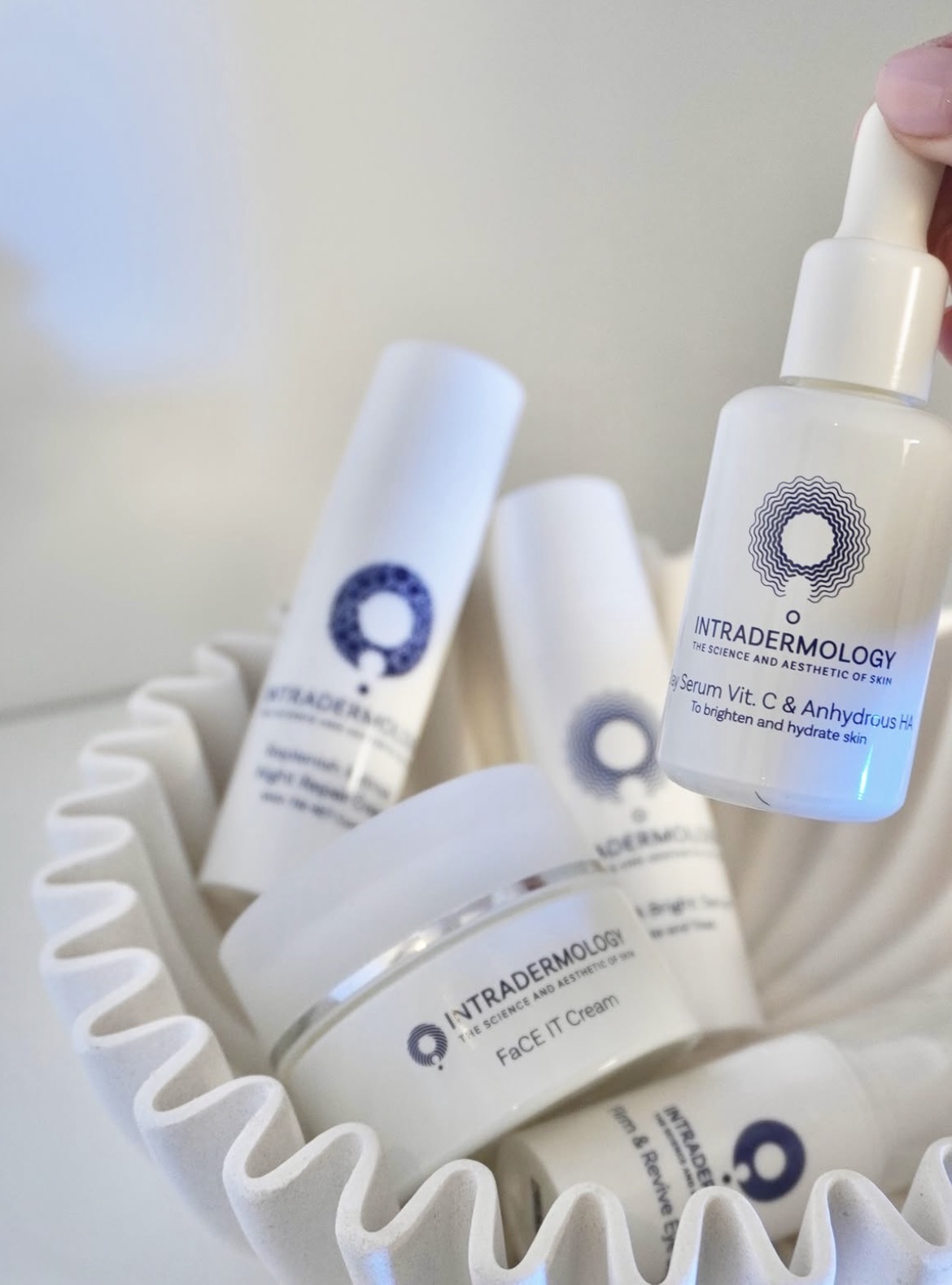
Pure L-ascorbic acid is notoriously unstable, harshly acidic, and degrades on contact with light and air. Ascorbyl Tetraisopalmitate is oil-soluble, remarkably stable, and delivers Vitamin C in an anhydrous format that supports the skin rather than stripping it. It costs more and it is harder to formulate with. It is also why Day Serum Vit C Anhydrous works beautifully for the dry, dehydrated and sensitive clients that harsh Vitamin C serums have historically excluded.
Sonicated hyaluronic acid, not standard HA
Standard hyaluronic acid hydrates. Sonicated HA (hyaluronic acid processed through a patented ultrasound technology) is documented in cosmetic literature for hydration alongside a measurable reduction in inflammatory cytokine signalling in skin cells, specifically the IL-8 pathway.
Every serum in our Stage 2 range uses sonicated HA as its base. Not because it costs less, because it does not. Because barrier-compromised skin responds better to hydration that also calms.
The TRI-RET complex, not one high-percentage retinoid
Off-the-shelf retinoid products typically use a single retinoid, usually retinol, at whatever percentage clients can be pushed to tolerate.
TRI-RET uses three complementary retinoids: retinol, encapsulated retinaldehyde, and Hydroxy Pinacolone Retinoate. Three pathways, three tolerability profiles, working as one coordinated system rather than a single active pushed to its limit. The encapsulation on the retinaldehyde is chosen deliberately for stability and controlled release, and that is not something you build with off-the-shelf formulation chemistry.
PEP-UP: where the formulation is the point
PEP-UP is not a hero ingredient dropped into a base formula. Palmitoyl Tripeptide-8 for skin-calming and comfort. SH-Polypeptide-3 and SH-Oligopeptide-2, recombinant peptides researched for their role in skin renewal pathways. Pseudoalteromonas Ferment Extract, a marine ferment researched for barrier-supportive properties. Then a skin-identical lipid system: Ceramides 1, 3 and 6-II with Cholesterol and Phytosphingosine.
Every ingredient is chosen for how it works alongside the others, and that coordination is genuinely hard to build.
Percentage matters, but so does the rest of the barrier-first formulation
So does the form of the active. So does the delivery system. So does the tolerability profile. So does the barrier-support architecture around it. So does the way every ingredient interacts with every other.
Off-the-shelf brands optimise for what the label can shout about. Sophisticated brands optimise for what happens to the skin. That is the difference. That is Intradermology®.
What barrier-first formulation means for your clinic
We work with European laboratories and formulating pharmacists who specialise in advanced actives, encapsulation and delivery chemistry, not off-the-shelf contract manufacturing. Claire sits in on formulation decisions, because the how matters as much as the what.
In practice, barrier-first formulation gives you products you can put on sensitive and barrier-compromised clients rather than working around them, and a reason to recommend them that holds up when a client asks why this serum and not the one on the high street.
You can view the full range on here, or see our training for practitioners. For trade prices and stockist information, email info@wowfacial.co.uk. All trade prices are quoted ex VAT.
Trained by professionals. Formulated by pharmacists. Chosen by clinics.
Intradermology® is a brand by WOW facial Ltd.